

CHAIRMAN'S STATEMENT
For NAMA, one of the main purposes of this Annual Report is to explain what we are trying to achieve and how we are progressing. Given our scale, we cannot be oblivious to our impact on the Irish property market and on the economy in general. It is important that we be as clear and as open as is possible so that taxpayers can assess the task facing us and judge how well or otherwise we are managing it. Our first two Annual Reports in 2010 and 2011 were heavily focused on the valuation and transfer of over €74 billion in loans to about 800 debtor connections (comprising over 5,000 debtors) and on our initial engagement with those debtors. The current 2012 Annual Report shows how our focus has adjusted as we have evolved to a more mature developmental phase of our work, guided by the overarching objective of extracting as much value as possible from our acquired loans and adding real value for the taxpayer.

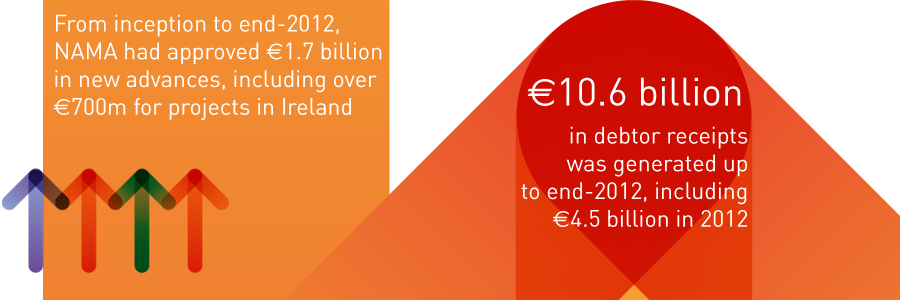
The Chief Executive, in his statement, sets out progress on a number of fronts, including the continuing profitability of NAMA and the significant achievement of the €10.6 billion in debtor receipts generated up to the end of 2012. This strong cash performance leaves us well placed to meet our first major debt repayment milestone, the redemption of €7.5 billion in Senior Bonds by the end of 2013. It also leaves us confident that we will repay all of our Senior Bonds by 2020. This is important from the perspective of international investors who see NAMA as part of the broadly positive Irish story that has emerged over recent years, one of resilience and, increasingly, of reinvigoration.
COMMERCIAL ACTIVITY
There are certainly more reasons to be positive now than might have been the case a year ago. For the Irish commercial market, recent activity suggests that a cautious optimism is warranted. With property prices down by more than 60% from their peak, prices have fallen to a level which makes the case for investment compelling. And, indeed, investors have taken note. Investment in the Irish commercial market in 2012 is estimated to have been of the order of €550m which, though hardly spectacular, is well up on the €200m of estimated investment activity in 2011. That momentum has been maintained into 2013 with commercial investment in the first quarter estimated to have been €336m. This has been driven by foreign investors attracted by the high yields available in the Irish market at a time when yields on many other asset classes, including bonds and cash, have fallen to very low levels. We have seen this investor interest at first hand: a loan portfolio secured by Irish assets that we recently brought to the market attracted interest from over 70 international property funds.
More generally, our approach to property assets in Ireland held by our debtors and receivers has been to encourage a phased and orderly realisation. It would have made no sense to have saturated the market over recent years with additional unwanted supply, particularly when credit was not available to many of those who were interested in buying and who would have been considered creditworthy in a properly functioning market. That said, our contribution to market activity has still been substantial: up to end-2012, our debtors and receivers had sold over 1,400 individual properties in Ireland and they currently have €1.5 billion worth of residential and commercial property on the market.
Part of our role also is to facilitate transactions that might not otherwise take place. I have referred to this previously as 'commercial matchmaking'. A good example of this is the €100m investment by the Kerry Group at Millennium Park in Naas, Co. Kildare which is expected to secure over 1,000 food technology jobs for Ireland.
FUNDING COMMERCIALLY VIABLE PROJECTS
An important element of our strategy is to fund the development and completion of commercially viable projects to increase their long-term recoverable value. From inception to end-2012, we had approved €1.7 billion in new advances, including over €700m for projects in Ireland. Examples include €20m to support the expansion of the Scotch Hall retail and leisure complex in Drogheda, €13m for the second phase of the Charlestown Shopping Centre in North Dublin and €24m for the completion of two residential apartment blocks in south Dublin.
Reflecting our asset management focus, we announced in May 2012 our intention to invest at least €2 billion in development capital in Ireland over the period to end-2016. Our primary objective for such investment is to generate a better return for the taxpayer when these projects are completed and the buildings involved can be sold or leased. There has to be a strong commercial rationale. The view has been put forward that we should use our cash resources, not to repay debt, but to fund construction activity without devoting too much attention to project evaluation. We do not accept this. Our view is that we should not spend what is essentially taxpayers' money on projects unless they can be shown to be commercially viable. At this stage, I would have thought that there are already enough monuments to ill-advised investment scattered throughout Ireland without NAMA adding to the collection.
So our approach to lending is prudent and is always backed up by good analysis. We are working with agencies such as the IDA and with local authorities to identify the type and location of new development for which there is likely to be demand. Our plans include delivery of quality, large-scale commercial office space needed to meet current and prospective demand from companies in the international technology, life sciences, banking, financial and other service sectors. We need to address this demand now if we are to avoid a shortage of prime office space in Dublin and other major cities over the medium-term. For this reason, we are already heavily involved at the planning stage in a number of sizeable projects: that involves securing viable planning permission, determining the most appropriate funding and delivery models and engaging with prospective purchasers and tenants.
As an example, we hold security over a considerable number of properties and lands on both sides of the Liffey and are currently assessing the commercial feasibility of a number of projects, including those in the undeveloped part of North Wall Quay on the north Docklands. The commercial feasibility of these projects is inextricably linked to the resolution of planning and infrastructural issues, issues which are largely beyond our control and which could affect the timing of our investment. In this regard, the recent designation of part of the Docklands as a Strategic Development Zone ('SDZ') by the Minister for the Environment, Community and Local Government is very welcome. While the SDZ is important, it is only one element and the provision of key infrastructural facilities such as water and effluent is essential so that this area can be developed to its full potential.
We are also involved at the planning stage in a number of residential developments, particularly in the Dublin area where potential supply shortages may emerge over the medium-term unless appropriate action is taken now. Nationally, there is a serious housing mismatch between areas with excess supply and areas where demand is most acute. Notwithstanding an overall pattern of excess supply, it makes commercial sense for us to fund the development of housing in areas where people themselves are choosing to live and work, such as parts of Dublin and other urban areas.
WIDER CONTRIBUTION
Economic and financial results are very important, not least in these difficult times, but our remit is somewhat broader than that. We are particularly keen to contribute in the delivery of social housing. This we view as an area where there are benefits for all parties, from those who are provided with housing, to the local authorities whose waiting lists are reduced, and to NAMA and the taxpayer. While the pace at which social housing is delivered is not controlled by NAMA, we have worked hard to remove any obstacles which have emerged in a process which is complex and which involves quite a few stakeholders. For our part, we have made every effort to streamline the delivery process, not least through setting up a special purpose vehicle to take ownership of properties for which demand has been confirmed.
Another area in which we have been able to make a positive contribution has been in agreeing rent abatements to support struggling businesses and help to safeguard jobs and economic activity in general. To end-April, we had granted 222 applications for rent abatement with an aggregate annual value of €14m, an approval rate of 96%. Only ten of the eligible applications received to that date have been refused.
IBRC
In February 2013, the Government decided to appoint Special Liquidators to IBRC with a mandate to value and offer for sale the loans in the IBRC portfolio. We were directed by the Minister to acquire any loans left unsold after the Special Liquidators have completed their valuation and sales process. We were also directed to put a credit facility of €1 billion in place to the Special Liquidators to meet their ongoing funding requirements and we have done so. As part of the IBRC transaction, we issued Senior Bonds to a value of just under €13 billion to the Central Bank to acquire its floating charge over IBRC assets.
NAMA will not have much visibility on the portfolio to be acquired until the valuation and sales process has been completed. We know that a substantial proportion of the IBRC portfolio comprises commercial property loans and, to the extent that we acquire those loans, I expect that they will be complementary to our existing expertise and to the skillsets of our staff. Beyond that, however, it makes little sense to speculate on how we might manage the acquired portfolio until we have had an opportunity to assess it in some detail after its acquisition, which will probably be later in the year.
As with the current NAMA portfolio acquired under the NAMA Act, a major objective will be to manage the new portfolio in a cost-effective and efficient manner on behalf of the taxpayer. The acquisition price will have been determined by the Special Liquidators. After acquisition, NAMA will, under IFRS accounting rules, conduct an independent impairment review of the loans including an up-to-date assessment of loan cashflows and asset disposal values. I would expect that only then will we be in a position to prepare a comprehensive strategy for managing the new portfolio and indeed only then will we be able to come to an informed view of the value that we might be able to generate from it.
In the meantime, we are getting ready. We have established a special purpose vehicle (National Asset Resolution Ltd.) to acquire and manage the residual IBRC loans that the Special Liquidators do not sell to third parties. We have appointed Capita Asset Services as our primary and special loan servicer on the NAMA loans previously managed on our behalf by IBRC. Capita will be the primary servicer on loans with nominal balances of €41 billion and, for €5.1 billion of this, will provide special servicing in the management of over 300 debtors under a framework of delegated authority from us.
We also published in March a Request for Proposals ('RFP') seeking two service providers to take over primary and special loan servicing on two distinct IBRC loan portfolios that we may acquire later in the year. The new portfolios are, respectively, commercial property loans (including residential investment and development loans and business banking loans) and personal loans (principally residential mortgage loans). We envisage that we will operate in close conjunction with the service providers for these portfolios, including providing them with credit, legal, treasury, finance and accounting services.
So while one of the few certainties right now about the IBRC portfolio is that it will add greatly to our balance sheet and responsibilities, we are well advanced in terms of preparing to take it on.
CONCLUSION
The backdrop to this year's Annual Report is more positive than at any other time over the past three years. The Irish property market is showing encouraging signs of recovery, the Exchequer finances are improving, Ireland is back in the sovereign debt markets and is beginning to attract the level of domestic and inward investment that is needed to create jobs and to build a sustained economic recovery. As we look back on what has been a very successful year for NAMA, it is appropriate that I acknowledge the very hard work of the Board, the staff, the Executive team and the CEO in NAMA in bringing this about. The results speak volumes for the dedication and commitment of all.
We will continue to make our contribution to economic recovery and we will manage our new mandate from Government on IBRC with the same vigour and commitment that has yielded the very positive results on our original portfolio that we have been able to outline in this Report.